
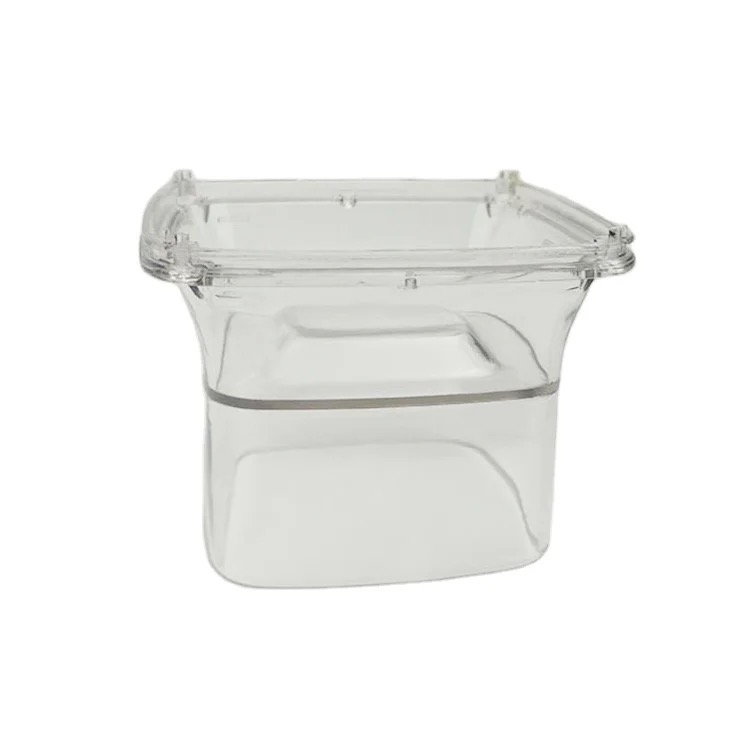
PC injection services
Polycarbonate is another clear injection molding resin that has excellent optical properties and is extremely durable. When molding with this amorphous thermoplastic material, precise dimensional control can be maintained as it has predictable and uniform mold shrinkage. We use polycarbonate when we need something substantially stronger than acrylic. However, be aware that if you’re making optically clear plastic parts the mold tool must be highly polished, which in turn implies the use of a higher grade of stainless steel that costs more. Now, you can see that your choice of plastic resin can very much influence the appropriate mold tool material as well.
Description
Polycarbonate is used in a number of industries due to its strength, optical clarity, and thermal resistance. Some key application examples of polycarbonate injection molding are listed below:
- Eyeglasses and Lenses:Polycarbonate is often used for eyeglass lenses due to its clarity and resistance to UV (Ultraviolet) light when UV stabilizers are incorporated into the base material.
- Medical Devices:Polycarbonate has excellent corrosion and thermal resistance and can be sterilized using irradiation, ethylene oxide, or steam autoclaving. Coupled with its optical clarity, polycarbonate is an ideal material for medical devices that require sterilization as these processes often require elevated temperatures. Applications include catheters, syringes, and incubators.
- Consumer Products:Polycarbonate has excellent toughness and optical clarity, and is food safe, making it ideal for kitchenware like food processor mixing bowls, for example. Polycarbonate can withstand the temperatures required to keep equipment that contacts food clean and hygienic. It must be noted that polycarbonate can also be made to be opaque.
- Automotive Products:Polycarbonate is widely used in car headlights due to its toughness, resistance to UV light, high and low temperature, and transparency. Its resistance to impact also makes it excellent at resisting impacts from road debris.
What Are the Advantages of Polycarbonate Injection Molding?
injection molding offers many advantages compared to other polycarbonate processing technologies. Some of the key benefits are listed below:
1. Quick Cycle Time
Polycarbonate injection molding is significantly faster than other processing techniques like vacuum forming and machining for example. Quicker cycle times mean more parts can be manufactured in a given time frame, thereby reducing the cost per part.
2. Aids in Producing Parts with Precise Tolerances
Injection molding is an inherently accurate process provided the process conditions are precisely controlled and the molds are machined to the required tolerances and properly designed to compensate for shrinkage during cooling. Molds are designed to be slightly oversized to account for the shrinkage as the polycarbonate cools. Injection molded parts can be made to have consistent tolerances of ± 0.1 mm.
3. Makes it Possible to Accommodate a Range of Part Sizes
Injection molding allows for the creation of parts with a wide variety of sizes. Since injection molds can be made in almost any size, the lower end of the size range is limited by the ability to force the viscous polycarbonate to melt into small spaces. The upper end of the size range is limited by the space available to accommodate the mold halves in the injection molding machine.
4. Makes for Excellent Part-to-Part Repeatability
Injection molding makes use of a precision-machined mold that can produce parts with very high levels of consistency. There will always be small variations in part dimensions, within required tolerances. Statistical process control can prevent these small variations from becoming larger over time due to machine and mold wear, inconsistent process parameters, or material variation. This repeatability is especially beneficial for parts like lenses that must be manufactured with precision.
5. Aids in the Mass Production of Parts
When it comes to the mass manufacture of complex plastic parts, no technology beats the production rate of injection molding. Injection molding is often used to produce millions of parts per year with limited human intervention. This helps maintain a low cost per part.
6. Aids in Avoiding Surface Flaws
The surface finish of polycarbonate is extremely important in applications that benefit from its optical clarity like car headlights. Injection molded parts will take on the surface finish of the mold used. Injection molds can be polished to a mirror finish which means that this highly smooth surface will be transferred to the injection molded parts.
7. Uses Raw Materials Effectively
Injection molding makes efficient use of raw materials with minimal wastage. Subtractive techniques like CNC (Computer Numerical Control) machining will result in a lot of waste, whereas injection molding fills the mold with only the precise amount of material required. The only waste present during injection molding is the small amount of material found in the mold runners. Any wastage that does exist can be recycled.
8. Low Labor Costs
Injection molding is one of the fastest production technologies when it comes to the manufacture of plastic parts and is a highly automated process and requires very limited human intervention when compared to other processes like machining. Reduced human intervention results in reduced labor costs and ultimately results in a low cost per part.
9. Makes Products With Various Designs and Shapes
Provided the correct DFM (Design for Manufacturing) principles are followed, injection molding can be used to produce parts with a wide range of designs. These can include parts that use over molding and insert molding to create multi-material parts.
Reviews
There are no reviews yet.